Small Penis Syndrome (SPS): An Evidence-Based Perspective and Modern Treatment Options
Small Penis Syndrome (SPS) is a real and often misunderstood condition. It refers to persistent dissatisfaction or distress about penile size despite measurements that fall well within normal anatomical ranges. At Avanti Derma®, we see this concern frequently—not as vanity, but as a legitimate quality-of-life issue that affects confidence, intimacy, and personal identity. This article is designed as a reference-level overview for patients seeking accurate, evidencebased information. It explores the origins of SPS, reviews traditional psychological approaches, and explains why objective, non-surgical volume augmentation with soft-tissue fillers often provides more reliable and lasting relief than counseling alone in properly selected patients.
Small Penis Syndrome (SPS): An Evidence-Based Perspective and Modern Treatment Options
Small Penis Syndrome (SPS) is a real and often misunderstood condition. It refers to persistent dissatisfaction or distress about penile size despite measurements that fall well within normal anatomical ranges. At Avanti Derma®, we see this concern frequently—not as vanity, but as a legitimate quality-of-life issue that affects confidence, intimacy, and personal identity.
This article is designed as a reference-level overview for patients seeking accurate, evidence-based information. It explores the origins of SPS, reviews traditional psychological approaches, and explains why objective, non-surgical volume augmentation with soft-tissue fillers often provides more reliable and lasting relief than counseling alone in properly selected patients.
What Is Small Penis Syndrome?
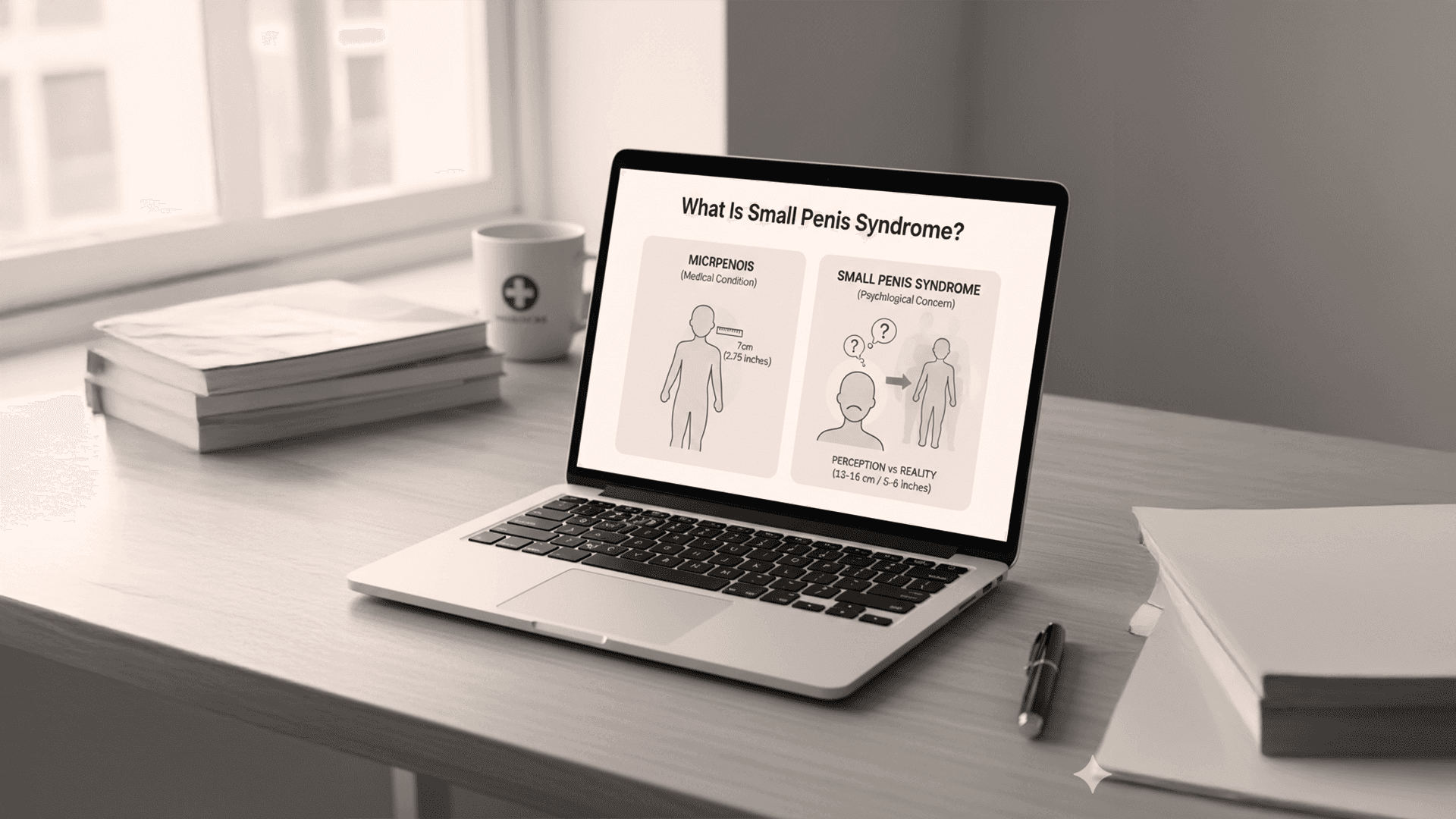
Small Penis Syndrome describes a condition in which a man believes his penis is inadequate in size even though objective measurements are within normal population standards. It is important to distinguish SPS from true micropenis, a rare medical condition usually diagnosed in infancy or childhood and related to hormonal abnormalities.
Men with SPS often report:
Persistent preoccupation with penile size
Anxiety in intimate or sexual situations
Avoidance of locker rooms or communal settings
Reduced sexual confidence despite normal function
SPS is not inherently a psychiatric disorder, though it may overlap with body-image concerns. Many men with SPS are otherwise psychologically healthy, successful, and emotionally stable.
The Role of Culture and Perception
Modern perceptions of penile size are heavily influenced by pornography, online forums, and exaggerated social narratives. Numerous scientific studies confirm that the average erect penile length worldwide is approximately 5–6 inches, yet many men believe the norm to be significantly larger.
This gap between statistical reality and perceived adequacy is where SPS develops. Reassurance alone often fails because perception—not measurement—is the source of distress.
Psychological Support: Helpful but Often Incomplete
Psychological approaches such as reassurance, sex therapy, or cognitive-behavioral therapy (CBT) can be beneficial, particularly when anxiety or relationship issues are dominant. These methods aim to reshape beliefs and reduce obsessive focus.
However, in real-world clinical practice, many patients tell us: “I understand the statistics—but I still don’t feel normal.”
One patient shared an anecdote that perfectly captures the paradox of SPS. While discussing his concerns with his wife, she reassured him by saying, “Your size is normal.” Instead of feeling relieved, he felt disappointed—because what he truly wanted to hear was not that he was normal, but that he was big.
This is a critical insight. Intellectual understanding does not always translate into emotional resolution. When dissatisfaction is rooted in physical perception and sensory experience, talk therapy alone may have limited impact.
Physical Treatment Options: Why Non-Surgical Matters
Surgical Procedures
Surgical penile enhancement techniques carry higher risks, longer recovery times, and less predictable cosmetic outcomes. For men with SPS—whose anatomy is already normal— surgery is rarely appropriate
Non-Surgical Soft-Tissue Filler Augmentation
At Avanti Derma®, we focus on minimally invasive penile girth enhancement using biocompatible soft-tissue fillers. These treatments are designed to increase circumference, tactile presence, and visual proportionality without altering erectile function or sensation.
Depending on the case, materials may include:
Collagen-stimulating fillers
Water-retaining hyaluronic acid gels
Medical-grade PMMA microspheres
All treatments are customized, conservative, and performed with strict anatomical precision.
Why Objective Volume Change Often Works Better
The Importance of Tangible Results
Human body perception is strongly reinforced by what we can see, feel, and experience. When a man observes a real, measurable increase in penile girth, several things happen:
Self-monitoring decreases
Confidence improves rapidly
Sexual interactions feel more natural and less self-conscious
Unlike verbal reassurance, physical enhancement provides objective confirmation that aligns perception with experience.
Clinical Outcomes
In properly screened patients, we consistently observe improvements not only in perceived size, but also in:
Sexual confidence
Relationship comfort
Overall body image satisfaction
These benefits tend to be durable because they are grounded in physical reality—not abstract reassurance.
Patient Selection and Ethics
Not every patient is a candidate for physical enhancement. At Avanti Derma®, we carefully screen for:
Unrealistic expectations
Severe body dysmorphic disorder
Psychological instability
When indicated and performed responsibly, non-surgical girth enhancement is ethical, safe, and clinically meaningful.
An Integrated Approach
The most effective strategy for SPS is not psychological versus physical, but psychological plus physical when appropriate.
A responsible care pathway includes:
Objective measurement and education
Psychological screening
Counseling when indicated
Conservative, staged physical enhancement for persistent dissatisfaction
This approach respects both the psychological and physical dimensions of male confidence.
Final Thoughts
Small Penis Syndrome is not trivial—and it is not imaginary. It reflects a disconnect between perception and reality that can deeply affect a man’s sense of self. While psychological support has value, objective, non-surgical volume augmentation with soft-tissue fillers often provides the most reliable resolution for carefully selected patients.
At Avanti Derma®, our goal is not to chase extremes, but to restore confidence through proportion, balance, and evidence-based care.
References
Casavantes, Luis. Girth Matters: A Comprehensive Guide to Non-Surgical Penile Enhancement. San Diego: Independent Medical Publications, 2023.
Veale, David, Sarah Miles, and Kirsten Read. “Penis Size Dissatisfaction: Association with Body Dysmorphic Disorder and Anxiety.” International Journal of Sexual Health 27, no. 2 (2015): 147–155.
Wylie, Kevan R., and David Eardley. “Penile Size and the ‘Small Penis Syndrome.’” BJU International 99, no. 6 (2007): 1449–1455.
Ponchietti, R., et al. “Penile Length and Circumference: A Study on 3,300 Young Italian Males.” European Urology 39, no. 2 (2001): 183–186.
Ghanem, H., et al. “A Systematic Review of Penile Girth Enhancement Procedures.” Journal of Sexual Medicine 15, no. 3 (2018): 277–286.
Casavantes, Luis. Clinical Perspectives on Non-Surgical Penile Enhancement. San Diego: Independent Medical Publications, 2024.