
What Happens After 10 Years? Long-Term Results of PMMA Phalloplasty
Dr. Luis Casavantes | Avanti Derma, Tijuana, Mexico
One of the most common questions a new patient asks during a consultation for nonsurgical phalloplasty is also the most reasonable one: What happens years from now?
It is a fair question — and one that deserves a straight answer rather than vague reassurances about permanence. PMMA microspheres do not dissolve. That is the point. But "permanent" is not the same as "unchanging," and patients deserve to understand what their anatomy will actually look like five, ten, and fifteen years after the procedure. What the long-term clinical record shows is largely reassuring — and where it asks for nuance, we will give it.
The Biology of Permanence: Why PMMA Stays
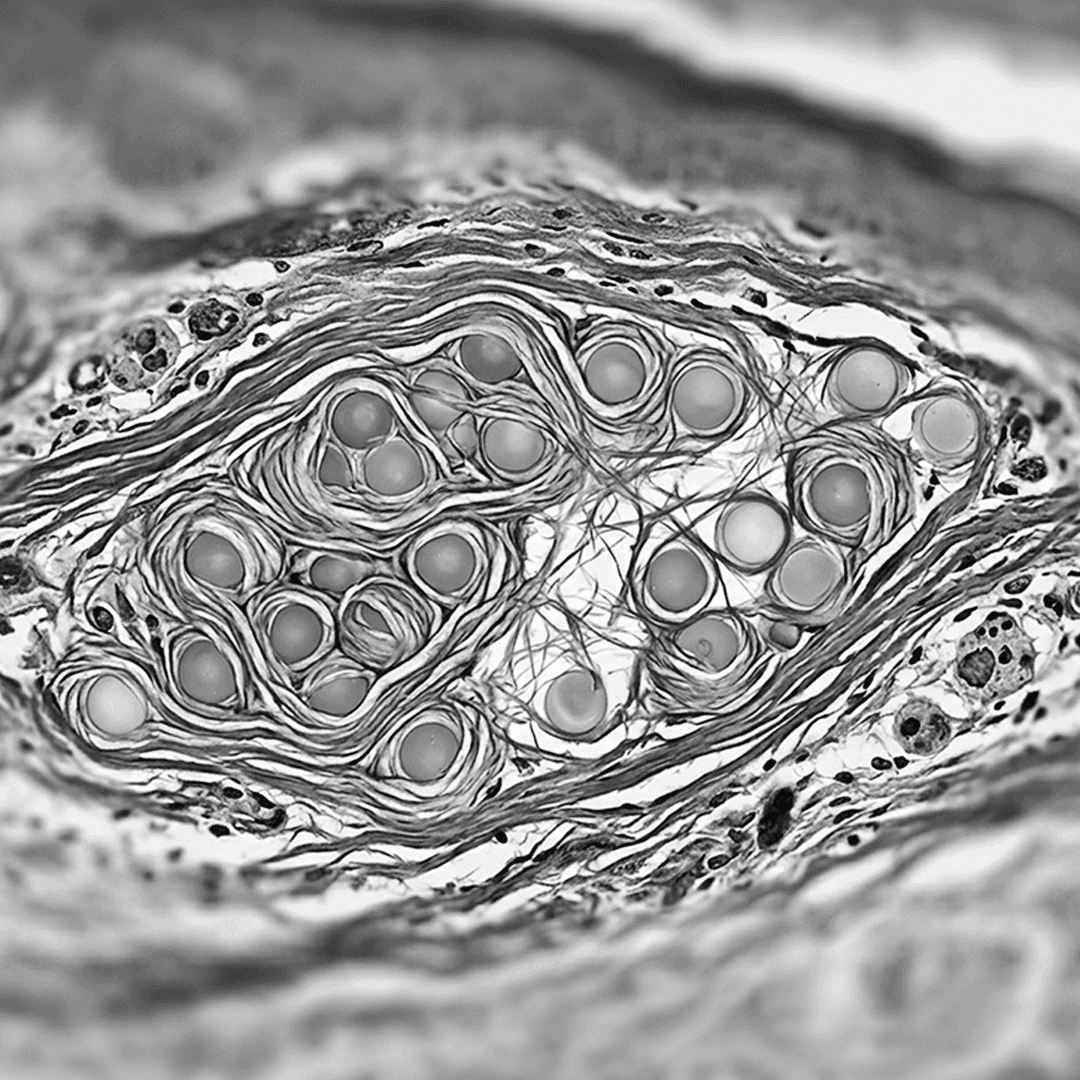
The mechanism behind PMMA's longevity is well understood. PMMA microspheres are too large to be phagocytized by macrophages. Rather than being degraded, they become encapsulated in a thick fibrous capsule — and it is this fibrous capsule that is responsible for long-term tissue augmentation and the prevention of microsphere clustering.
This is fundamentally different from how the body handles hyaluronic acid or other resorbable fillers. HA is gradually metabolized; PMMA is incorporated. Histological studies confirm that PMMA stimulates collagen-3 and procollagen-1 when injected into human skin, and that this combination of neocollagenesis followed by microencapsulation provides the foundation for long-lasting results. The tissue does not merely tolerate the microspheres — it builds around them.
Post-market surveillance data demonstrate clear evidence of long-term safety with PMMA through 12 years of follow-up. That is the longest documented clinical track record of any injectable filler currently in use.
What the Published Data Shows at Five Years
The most rigorously conducted long-term PMMA study is the Bellafill five-year post-approval trial — the largest and longest prospective dermal filler study ever conducted. In 1,008 patients followed over five years, researchers reported an 87% retention rate, with 83% of patients saying they were satisfied or very satisfied with their results. Among those studied, 11.7% experienced treatment-related adverse events, the most common being injection-site lumpiness and redness. Biopsy-confirmed granulomas occurred in 1.7% of patients.
These figures come from facial augmentation — nasolabial folds, acne scars, and volumization — not penile augmentation specifically. But the underlying material is the same, and the tissue biology is governed by the same principles.
For penile augmentation specifically, Avanti Derma's own published data — the largest single-center dataset in the literature — followed 729 patients over seven years. Patients achieved an average girth increase of 3.5 cm after one to three injection sessions. Approximately half reported some palpable irregularities such as nodularity or ridges, which did not cause significant dissatisfaction. The erectile aspect of sexual function was not affected, due to the independence of the PMMA implant from the corpora cavernosum and corpus spongiosum. The complication rate requiring intervention was 0.4%.
That last figure deserves emphasis: in nearly 750 patients followed for up to seven years, fewer than 1 in 200 required any procedural intervention for a complication. The satisfaction rate held at 8.7 out of 10.
Honest Nuance: What "Permanent" Actually Means
PMMA does not change. But the body around it does.
Tissue aging, weight fluctuation, and the natural laxity that develops in penile skin over years can affect the appearance and feel of the augmentation. The volume deposited by PMMA remains — the collagen scaffold is stable — but the overlying tissue continues to evolve. This is why the concept of a "touch-up" session years after an initial procedure is not a sign that the treatment failed. It is the same logic that applies to any aesthetic intervention made in living tissue.
What PMMA does not do is reabsorb, migrate in a clinically meaningful way when properly injected, or require the annual maintenance cycles that HA demands. The collagen scaffold built around PMMA microspheres is expected to be mostly permanent when correctly placed, with touch-ups needed only for symmetry refinement or additional size, not for volume replacement.
What Patients at Avanti Derma Experience Over Time
The patients who return to our clinic years after their procedure overwhelmingly report one thing above all: the results held. Girth is maintained. Sensitivity is intact. Sexual function is unaffected.
The patients who return with concerns most commonly report one of two things: minor surface irregularities — small nodules or ridges palpable under the skin — or a desire for additional volume. Neither of these is a failure. A comprehensive review of penile augmentation procedures confirms that PMMA microspheres appear to be safe, stable, and effective long-term, with patient satisfaction consistently high across follow-up periods.
The rare patient who develops a delayed inflammatory reaction — most often associated with biofilm — presents a more complex clinical picture, and one that requires a specific treatment protocol. This is not a PMMA-specific phenomenon; it can occur with any permanent foreign body. The published literature and our clinical experience both confirm that it is manageable in the overwhelming majority of cases when identified early.
The Honest Bottom Line
No practitioner can show you a randomized controlled trial with thirty-year PMMA penile augmentation follow-up data — because the procedure is not thirty years old, and because clinical trials of this complexity take generations to complete. What exists is a growing body of evidence across multiple material generations, multiple patient populations, and multiple anatomical sites — all pointing in the same direction.
PMMA, when injected at the correct depth by an experienced practitioner using appropriate technique, delivers results that are durable, safe, and clinically validated through at least a decade of post-market surveillance. The biology is well understood. The long-term adverse event profile is documented and rare. The satisfaction rates are high.
That is not a sales pitch. It is what the evidence says — and at Avanti Derma, the evidence is where every conversation starts.
Clinical Takeaways
PMMA microspheres are incorporated into the body through fibrous encapsulation, not reabsorbed — making augmentation structurally durable over time.
Post-market surveillance data supports PMMA safety through 12 years across multiple anatomical sites.
Avanti Derma's seven-year penile augmentation dataset shows 8.7/10 satisfaction and a 0.4% complication rate requiring intervention in 729 patients.
"Permanent" means the volume scaffold endures — not that surrounding tissue stops aging. Refinement sessions address tissue evolution, not material failure.
Delayed inflammatory reactions are rare, manageable, and not unique to PMMA among permanent foreign body implants.
Bibliography
Casavantes, Luis, Gottfried Lemperle, and Palmira Morales. "Penile Girth Enhancement with Polymethylmethacrylate-Based Soft Tissue Fillers." Journal of Sexual Medicine 13, no. 9 (2016): 1414–1422. https://doi.org/10.1016/j.jsxm.2016.07.003.
Casavantes, Luis. Girth Matters: A Comprehensive Guide to Nonsurgical Male Enhancement. Avanti Derma, 2022. ISBN 978-1-7374986-0-5.
Cohen, S., J. Dover, G. Monheit, R. Narins, N. Sadick, and W. P. Werschler. "Five-Year Safety and Satisfaction Study of PMMA–Collagen in the Correction of Nasolabial Folds." Dermatologic Surgery 41, Suppl. 1 (2015): S302–S313. https://doi.org/10.1097/DSS.0000000000000542.
Lemperle, Gottfried. "Background/Basic Science of Polymethylmethacrylate Fillers." Rejuvenation Resource, March 9, 2021. https://www.rejuvenationresource.com/articles/background-science/background-basic-science-of-polymethylmethacrylate-fillers.
Chawla, S. "Histologic Characterization of Polymethylmethacrylate Dermal Filler Biostimulatory Properties in Human Skin." Dermatologic Surgery 46, no. 4 (2020): 544–548. https://pubmed.ncbi.nlm.nih.gov/31765337/.
Manfredi, C., J. Romero Otero, and R. Djinovic. "Penile Enhancement: A Comprehensive and Current Perspective." Current Urology (2024). https://pmc.ncbi.nlm.nih.gov/articles/PMC12076428/.
Kwak, T. I., et al. "Long-Term Safety and Longevity of a Mixture of Polymethyl Methacrylate and Cross-Linked Dextran (Lipen-10®) after Penile Augmentation: Extension Study from Six to 18 Months of Follow-Up." PMC (2015). https://pmc.ncbi.nlm.nih.gov/articles/PMC4709437/.
Bellafill for Physicians. Suneva Medical. Accessed June 2025. https://bellafill.com/for-physicians/.